
Practice Questions and Sample Papers
Understand question formats and develop accuracy through structured practice.
Explore practice resourcesOlympiad Education
12 Jul 2026 · ScienceX Editorial · 15 min read
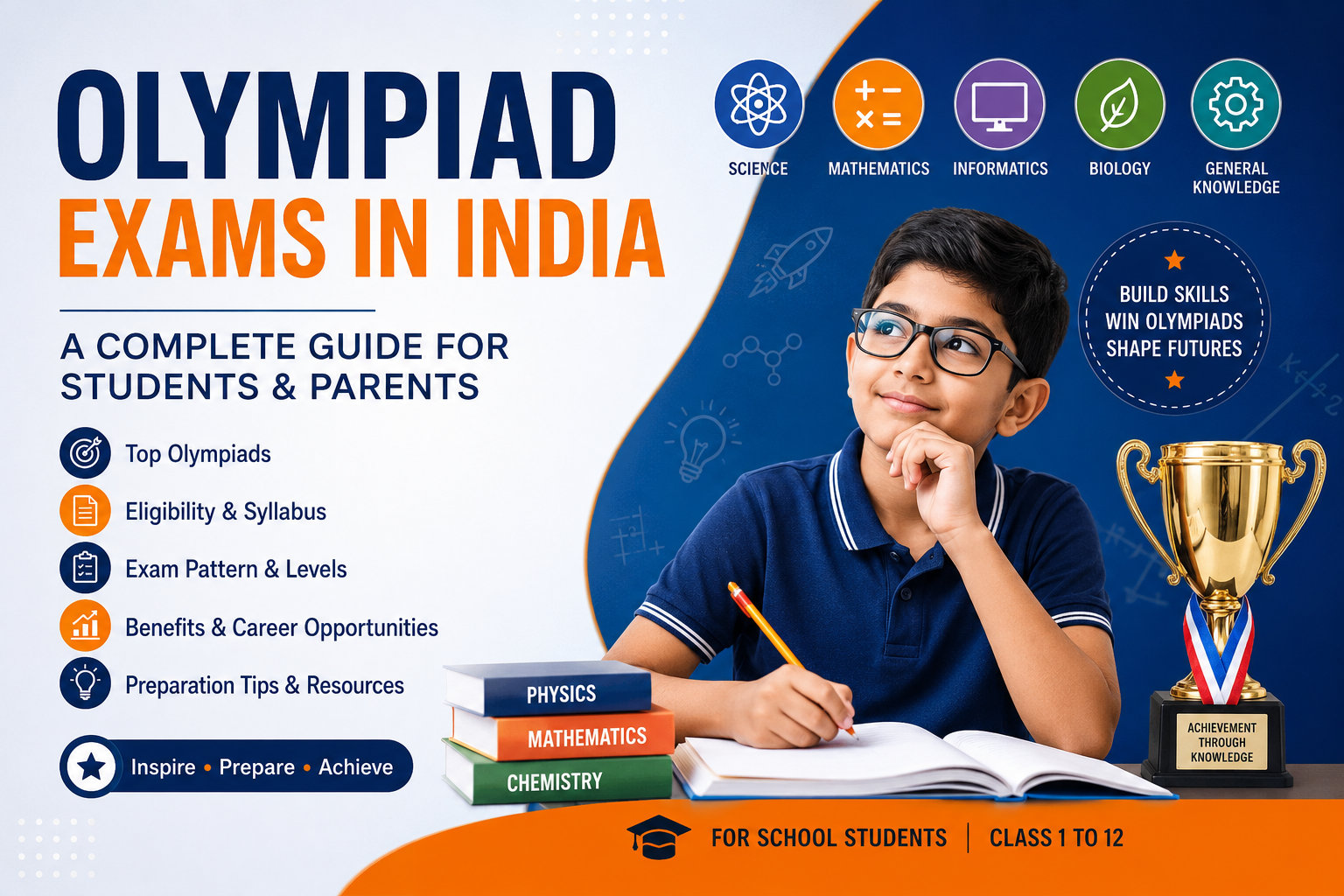
Understand the meaning, types, subjects, eligibility, examination patterns, benefits, preparation strategies and registration process for Olympiad exams in India.
Olympiad exams are academic competitions that assess a student's knowledge, reasoning ability, conceptual understanding and capacity to apply ideas to unfamiliar problems. They are conducted in different subjects and for different age or class groups.
Unlike many routine classroom tests, Olympiad questions generally require students to do more than recall a definition or reproduce a memorised solution. A student may need to interpret information, connect multiple concepts, identify a pattern, eliminate unsuitable options or determine the most logical answer.
The word Olympiad is used for different kinds of academic competitions. Some form part of structured national selection programmes leading towards recognised international Olympiads. Others are independent school-level competitions organised by educational institutions or private organisations to encourage subject learning and academic participation.
Not every examination using the word “Olympiad” is part of India's official national selection programme for international Olympiads. Parents and students should check the organising body, objectives, eligibility, selection stages and recognition associated with each examination.
The central purpose of an Olympiad is to challenge learners beyond ordinary recall-based assessment. Olympiads encourage students to understand why a method works, how a principle can be applied and which information is relevant to solving a problem.
Depending on the subject and organising body, an Olympiad may assess:
Participation can be valuable even when a student does not receive a top rank. Preparation exposes students to new question formats and helps them discover their strengths and areas requiring improvement.
The Olympiad landscape in India includes different programmes with different academic purposes. Understanding these distinctions helps families make informed choices.
| Category | Main purpose | Typical participants | Common structure |
|---|---|---|---|
| Official national Olympiad programmes | Identify and train students who may progress towards international subject Olympiads | Eligible secondary and senior-secondary students | Multiple competitive selection and training stages |
| School-level national Olympiads | Promote subject learning, reasoning, benchmarking and participation | Students across specified school classes | Usually one or more examination levels |
| Online Olympiads | Provide accessible digital participation and assessment | Students meeting the organiser's class or age criteria | Online registration, remote examination or centre-based digital test |
| Institutional competitions | Encourage talent, innovation or subject-specific exploration | Students selected by schools or registering individually | Written examinations, quizzes, projects or practical challenges |
India's national Olympiad programme in Science and Mathematics follows a multi-stage structure, although the procedures are not identical across subjects. Independent school Olympiads may instead use single-stage or two-stage examinations and serve a broader school population.
Students should not choose an examination only because it includes words such as “national” or “international” in its title. The organiser, syllabus, level of competition and learning objectives are more useful indicators.
Official programmes are highly competitive academic pathways designed to identify and train students for participation in recognised international Olympiads. These programmes generally involve several qualifying, selection and training stages.
Their eligibility requirements, syllabuses and selection procedures can be significantly different from regular school Olympiads. Students interested in these programmes should consult the current official notification for the relevant subject.
School-level Olympiads are conducted by various educational organisations. They are usually designed for wider participation and may cover students from primary to senior-secondary classes.
These examinations may help students:
Online Olympiads provide digital participation through computers or compatible devices. Depending on the organiser, the examination may be taken from home, from school or at a supervised centre.
Before registration, families should verify technical requirements, identity-verification rules, examination monitoring arrangements and whether a mock test is provided.
Some competitions combine academic knowledge with practical problem-solving, coding, experimentation, engineering design, research projects or innovation challenges. These can be especially valuable for students who enjoy learning by creating and testing ideas.
| Subject | Areas commonly assessed | Skills developed |
|---|---|---|
| Science | Scientific concepts, observations, experiments, environment and everyday applications | Scientific aptitude, analysis and evidence-based reasoning |
| Mathematics | Numbers, algebra, geometry, measurement, patterns and problem-solving | Logical reasoning, precision and mathematical thinking |
| Physics | Mechanics, electricity, magnetism, waves, optics and modern physics | Modelling, quantitative analysis and conceptual application |
| Chemistry | Matter, atomic structure, reactions, periodicity and chemical principles | Analytical reasoning and interpretation of chemical behaviour |
| Biology | Living organisms, cells, genetics, physiology, ecology and evolution | Observation, classification and biological reasoning |
| Astronomy | Solar System, stars, galaxies, celestial motion and space science | Spatial understanding, scientific reasoning and curiosity |
| Artificial Intelligence | AI concepts, data, algorithms, ethics and computational reasoning | Digital literacy, computational thinking and problem-solving |
| Computer Science | Computing fundamentals, algorithms, coding logic and digital systems | Algorithmic thinking and structured problem-solving |
| English | Grammar, vocabulary, comprehension and communication | Language proficiency and interpretation |
| General Knowledge | Current affairs, history, geography, science, culture and civic awareness | General awareness, recall and information interpretation |
The exact subjects available depend on the organising body and examination cycle. Students should select subjects according to their interests, class level and preparation capacity instead of registering for too many examinations at once.
There is no single eligibility rule for every Olympiad examination in India. Each organising body defines its own participation requirements.
Eligibility may be based on:
| Check | Why it matters |
|---|---|
| Eligible classes | The Olympiad may only be available for specified classes. |
| Age or date-of-birth condition | Official selection programmes may use strict age requirements. |
| Registration route | Some examinations accept only school registrations, while others permit individual registration. |
| Required documents | A school identity card, date-of-birth proof or other documentation may be required. |
| Previous stage qualification | Advanced stages may be open only to students who qualified in an earlier stage. |
| Subject restrictions | Some senior-level Olympiads require students to meet specific academic conditions. |
Never rely on an old blog article for current eligibility. Always check the latest official notification before paying a registration fee.
Olympiad registration may take place through a participating school, an authorised examination centre or an official online registration portal.
Under school registration, a teacher or school coordinator collects student details, selects subjects, submits the registration and manages examination-related communication.
Some organisers permit students or parents to register directly through an online portal. The applicant usually selects the class, subject, examination date or mode and then completes the payment.
Registration dates, fees, examination centres and modes may change between academic cycles. Students and parents should use the official website of the relevant organiser as the final source of information.
There is no universal Olympiad examination pattern. Some school Olympiads use multiple-choice questions, while advanced Olympiads may use numerical answers, proofs, descriptive solutions, experiments or practical assessments.
| Feature | Possible format |
|---|---|
| Question type | Multiple-choice, numerical answer, descriptive, proof-based or practical |
| Mode | Offline, online or hybrid |
| Number of stages | Single stage, two levels or multiple selection and training stages |
| Marking | Positive marking, negative marking or no penalty |
| Difficulty | School curriculum enrichment to advanced competition level |
| Language | English or other languages specified by the organiser |
| Duration | Varies according to subject, class and stage |
Many school-level papers contain a combination of:
Students should study the official sample paper rather than assuming that every Olympiad follows the same pattern.
| Basis | Regular school examination | Olympiad examination |
|---|---|---|
| Primary objective | Assess learning from the prescribed school curriculum | Assess deeper understanding, reasoning and application |
| Question style | Direct, descriptive, objective or curriculum-based | Often analytical, unfamiliar and application-oriented |
| Comparison group | Usually a class or school group | May include students from multiple schools, regions or countries |
| Preparation focus | Textbook chapters, classroom notes and prescribed exercises | Concept mastery, varied practice and reasoning |
| Outcome | School grades or academic progression | Learning experience, score, rank, qualification or recognition |
The two forms of assessment should not be treated as opponents. School education provides the conceptual foundation, while Olympiads can offer additional opportunities to practise application and higher-order thinking.
Olympiad preparation encourages students to understand principles instead of memorising isolated answers. This supports better retention and application.
Students learn to examine information, recognise patterns, compare alternatives and reach conclusions systematically.
Regular exposure to unfamiliar questions teaches students how to divide a problem into manageable parts and test possible solutions.
Science-focused Olympiads can cultivate observation, questioning, interpretation of evidence and an interest in understanding natural phenomena.
Completing a competitive examination gives students experience in working independently under time limits. Improvement through practice can strengthen confidence.
Preparation often reinforces important classroom concepts and reveals topics that require further revision.
Students learn to use syllabuses, sample papers, reference material and digital resources to manage their own preparation.
Where properly designed, score reports can help students understand their relative strengths. Rankings should, however, be interpreted as one indicator rather than a complete measure of ability.
Olympiads can motivate students to set goals and engage with subjects beyond minimum classroom requirements.
Practice with timed papers, OMR sheets or online tests can improve accuracy, concentration and time management.
Certificates, medals and ranks can motivate students, but they should not become the only purpose of participation. Conceptual growth, curiosity and confidence are more meaningful long-term outcomes.
Read more in our detailed guide: Benefits of Participating in ScienceX Olympiads .
The “best” Olympiad is not necessarily the one with the biggest title or the largest number of awards. It is the examination that appropriately matches the student's interests, class, current ability and learning goals.
| Question | What to examine |
|---|---|
| Who organises it? | Identity, official website, academic purpose and transparency of the organising body |
| Is the subject suitable? | The student's interest, class level and existing academic foundation |
| What is the syllabus? | Whether the content is appropriate and clearly published |
| What is the question level? | School enrichment, advanced competition or international-selection level |
| How is it conducted? | Online or offline mode, supervision and technical requirements |
| Is registration school-based? | Whether the student can register individually or needs a school coordinator |
| What feedback is provided? | Score, rank, answer key, performance report or qualification status |
| What is the total cost? | Registration, preparation materials, travel and other associated expenses |
| What is the recognition policy? | Published rules for certificates, medals, ranks or further stages |
Avoid registering a student for many subjects merely to increase the number of certificates. Focused preparation for one or two suitable subjects is often more educationally meaningful.
Download the current syllabus and sample paper from the official website. Prepare a checklist of topics and note the question types, duration and marking system.
Begin with school textbooks and classroom notes. A student should understand definitions, principles and standard methods before attempting advanced questions.
After learning a concept, solve questions that present it in different situations. This teaches students to identify which principle should be applied.
Include puzzles, data interpretation, number patterns, classification, analogy and logical-sequence questions where they form part of the examination.
Sample papers help students understand the actual structure of the examination. They should be used first for learning and later under timed conditions.
Explore: Olympiad practice questions and sample papers .
Students should record questions they answered incorrectly, the reason for the error and the correct approach. Reviewing this notebook prevents repeated mistakes.
Learn to answer easier questions first, avoid spending too long on one problem and reserve time to review marked answers.
Use short weekly revision sessions instead of waiting until the final days. Formula sheets, concept maps and error logs can support revision.
Mock examinations help students become familiar with timing, instructions, OMR marking or the online examination interface.
Excessive pressure can reduce concentration and confidence. Students should maintain regular sleep, physical activity and appropriate breaks during preparation.
| Week | Primary focus | Recommended activity |
|---|---|---|
| Week 1 | Planning and diagnostic assessment | Review the syllabus, understand the pattern and attempt a short diagnostic test. |
| Week 2 | Fundamental concepts | Revise important textbook concepts and create topic notes. |
| Week 3 | Concept application | Solve chapter-wise application questions and review errors. |
| Week 4 | Reasoning and advanced problems | Practise logical reasoning and higher-order questions. |
| Week 5 | Mixed-topic practice | Solve questions from multiple chapters without referring to notes. |
| Week 6 | Sample papers | Complete one or two papers under partially timed conditions. |
| Week 7 | Mock examinations | Attempt full-length timed tests and analyse performance. |
| Week 8 | Final revision | Review concepts, formulas and errors without starting unnecessary new material. |
The plan should be adjusted according to the student's class, available time and existing preparation. Younger students generally benefit from shorter sessions and more activity-based learning.
Parents play an important role in creating a positive and balanced preparation environment. Support does not mean solving every problem for the student or placing excessive emphasis on rank.
Parents can help by:
A child who develops confidence and curiosity has gained something valuable even when the final rank is lower than expected.
Schools can create a stronger Olympiad culture by treating competitions as learning opportunities rather than only award programmes.
Useful school-level initiatives include:
Teachers can also use selected Olympiad-style questions during regular lessons to promote reasoning and discussion.
| Mistake | Why it causes difficulty | Better approach |
|---|---|---|
| Memorising answers | The same concept may appear in an unfamiliar form. | Understand the principle and practise varied questions. |
| Starting with very advanced material | Weak fundamentals make difficult questions confusing. | Build from textbooks to progressively challenging practice. |
| Ignoring the official syllabus | Preparation becomes unfocused. | Create a topic checklist from the current syllabus. |
| Collecting too many books | Students may read superficially without completing practice. | Use a small number of reliable resources consistently. |
| Not analysing mistakes | The same misunderstanding is repeated. | Maintain and revise an error notebook. |
| Taking mock tests too early | Scores may be discouraging before concepts are ready. | Begin with chapter practice and add full mocks later. |
| Studying only in the final week | There is insufficient time for conceptual improvement. | Use a regular preparation schedule. |
| Focusing only on rank | Pressure can reduce curiosity and confidence. | Track learning, accuracy and improvement. |
Identify the student's subject interests and suitable examinations.
Check the official eligibility, syllabus, pattern, dates and registration rules.
Build strong fundamentals through textbooks, lessons and concept revision.
Solve application-based questions, sample papers and mock tests.
Approach the examination calmly and follow all official instructions.
Analyse performance, appreciate progress and plan the next learning goal.
ScienceX Olympiads are part of the broader ScienceX Learning Ecosystem and are designed to encourage conceptual understanding, scientific aptitude, logical reasoning and analytical thinking among school students.
Through subject-focused academic assessments, ScienceX aims to provide students with opportunities to apply classroom knowledge, develop problem-solving skills and participate in meaningful academic competition.
Available subjects, eligible classes, examination dates, fees, awards and registration procedures are governed by the guidelines published for the relevant Olympiad cycle.
View the current Olympiad programmes, eligibility requirements, subject information, registration guidelines and preparation resources.
Understand question formats and develop accuracy through structured practice.
Explore practice resources